It seems like the EcoFlow systems are starting to get support in NUT too, and the river 3 plus specifically has a merged PR.
This is great news for sure, and should make it a viable option hooked up to a network wide nut server setup.
Looks like goldenmate is adding a version of their battery backup with communication capabilities for automated shutdown.
I own one of the goldenmates, I agree - very basic, no data readout, but it’s been quite reliable.
Anyone have suggestions on lithium based UPS’s I can get mailed to Puerto Rico? Goldenmate wont ship 
Anker Solix C300 (or larger)?
I recently picked up a Solix C300 to replace an aging APC UPS unit.
Pros:
- The Solix is smaller.
- The Solix has a light on it, which can be controlled through the smartphone app (bluetooth or wifi connection). Nice when I’m working under my desk and trying to read labels. The light has various brightness settings.
- The Solix tells me real-time power usage. Previously I had hooked up my Kill-A-Watt to check what the APC unit was pulling.
Cons:
- The Solix needs a power strip to support the 4 devices (1 tower, 1 Dell SFF, 2 NUCs) I have on my desk here.
Running for a good 48 hours, so far so good. 
I’ve disabled most of the “fancy” features as they are designed for if you’re using this thing as a portable power bank. I don’t want the AC outputs to ever shut off, so turning off “Smart AC Output Mode”.
Sample settings UI below.
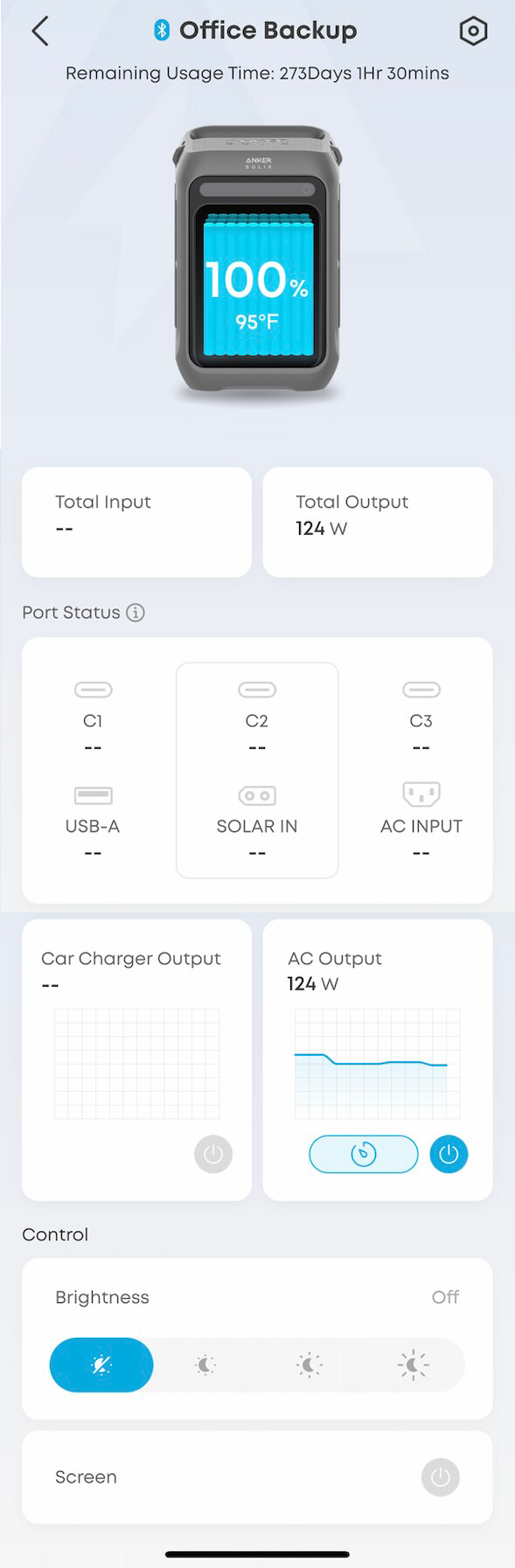
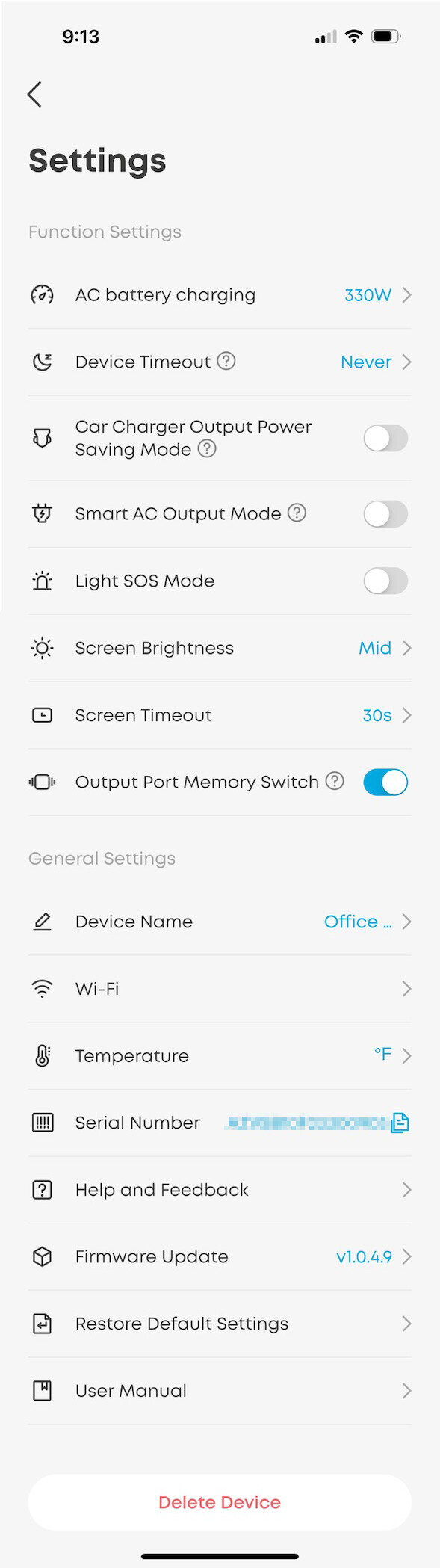
Almost two months later - this thing is great, haven’t even thought about it since install.
South Korean Government enters the chat.
I was similarly impressed by what I had heard and read about these units. I now have a smaller one for the network stack and a larger capacity for the hypervisor and NAS. They replaced two APC UPSs that were due for new batteries. No real complaints so far although I miss the UPS integration and comms that were possible for metrics and alerts.
Did you try this yet? My experience with trying to put two APC UPS was not successful. Even “pure sine wave” UPS could not pass the power quality check. Limiting the input power to the downstream UPS could be helpful.
Either this or plugging a smaller UPS into larger one My best guess was that they were too electrically noisy as either a source or load or that the demanded charging current tripped the inverters. possibly work.
I never picked up a Goldmate unit so was not able to test if this would work.
Has anyone found any good solutions for rack mounting these lithium power stations from Anker or Ecoflow? I’m redoing my network setup and a clean rack-mount solution plus a better power system would be a nice reason to upgrade.
I bought one of the Goldenmate 1500 VA / 1000 W UPSs. It seems to work well. Its pretty quiet for the most part, it occasionally makes a faint, low hum. The display is nice, but I haven’t figured out how to get it to stay on. It has done its job through several short power outages. The biggest surprise was how big it was. The APC 1500 VA UPSs I’ve had in the past were fairly compact, but this one seemed easily twice the size (volume). The dimensions are: 16.73"D x 6.3"W x 11.81"H.
I didn’t realize how much power printers take, but I plugged in my small brother laser printer, it made an overload alarm come on the UPS (but it didn’t drop load, it was on line voltage). Steady state and printing its uses very little. So I will probably only plug things that are absolutely necessary into the UPS.
You may already know this, but maybe it will help someone:
For physical size, you have to consider the energy-capacity—watt hours (Wh) available—not the load-capacity (power capacity)—VA or Watts W. If the Goldenmate is much larger physically, but has the same Wh capacity, then that would be disappointing. If it has twice the Wh capacity, then that justifies the larger physical size.
That link overview says it is 296 Wh. In my experience, batteries are sometimes optimistic on their claimed/marketed capacity. As Jim said above, just test, and it sounds like you have done so with your printer already.
For a truly “scientific” test, a lot of things need to be controlled. Maintain a consistent load, verified by a third-party, independent power meter. Run to shut-off, timing with a clock. Then you will know if the marketed capacity is legit.
To compare with another unit you also have to consider temperatures of components and sub-components, not just ambient. Higher current and higher component temps will increase system resistance, which will increase parasitic loss. If you power meter is at the wall, it should do an ok job of capturing the total power used, but if you want to know how much is reaching your computer, you’ll need another power meter in between the UPS and the computer.
Ok, I have been pedantic probably more than enough. 
I would like to see Anker include AVR. It seems most of the power stations do not include AVR. I think I saw one from Ecoflow that had it but it was in the larger (overkill) unit for a home network UPS. It would make more sense to include it in the smaller units because those are more likely to be appropriate for home networks & other sensitive devices. We rarely get power outages where I live but we often get brown outs with voltage drops, enough to drop devices to no power. Without AVR, the powerstation may not respond to a voltage drop to say 70-80V, but the PSU’s will lose power.
There is also the issue of surge protection in power stations. Most don’t have true surge protection. I suppose you could add a surge protection outlet strip somewhere to address this.
The GolednMate’s seem to be coming along nicely. Haven’t purchased anything yet. I’m torn… I really like the Anker brand.
I just got the Anker C1000 gen 2. I can say it works everything without a hitch so far. The test I threw at it toady, was to turn off the breaker for the circuit it is connected to, while we performed an electrical modification on that wall outlet. You would hire an electricial to do this, but I wanted to flip the outlet so I could plug in a Tripp Lite Isobar surge supressor block. Otherwise, the orientation of the outlet was a problem for this to work. The important part is everything switched over to batter without any delays.
2 workstations
1 router computer (w/ i5-12500) - could be a workstation itself
20W POE injector
3 5-port dumb switches
Samsung 32" monitor
Bose computer speakers
and a Desk lamp so I could see
After about 45 minutes, and I let it goe for an hour, everything kept working, battery was 96% after powering the curcuit back on.
The C1000 is overkill I know but it’s small enough, not much bigger than the Cyberpower Lead-acid batter UPS that I replaced. The c800 and probably even the C300 would have been plenty. I got a good deal on it, so there you have it 
Isn’t that runtime just incredible? 
I couldn’t be more pleased with it. Glad you mentioned Anker earlier here. I had never thought of a power station as a UPS.
I just wanted to show some gratitude for this thread and for Jim’s suggestion about the Anker Solix power banks.
I bought a C300 and a C800X shortly after reading the suggestion and yesterday they absolutely made the purchase worthwhile. High winds took out a transmission line and our family was without power for over 5 hours with subfreezing temperatures outside. This setup allowed us to outlast not only my ISP’s backup power, but also the nearby cell tower’s too.
C800X
The C800X was able to easily cover all of my necessities, including heat (~110 watts), a slow cooker (~250 watts), my two servers (~400 watts combined), as well as my network/internet gear (~100 watts). Not all of these were active at the same time. We traded the servers and network equipment for the slow cooker once the ISP connection went down and our tummies started to growl. 
The built in light and the two ‘lantern’ type lights worked great for improving visibility while getting everything connected in dark rooms. We didn’t actually drain the pack completely since we didn’t know how long the power outage would be. Instead we opted to fire up the generator once the pack hit about 40%. The ability to throttle the charge rate of the battery pack worked a treat to prevent overloading the generator while charging and powering all the things. The generator was able to fully charge the battery pack and we were able to shut it off to save fuel.
C300
The C300 was kept on reserve for charging personal devices. While it didn’t see much action it was very nice to know that we had multiple days worth of power for personal devices should we need it.
Awesome “after action report,” thank you!